
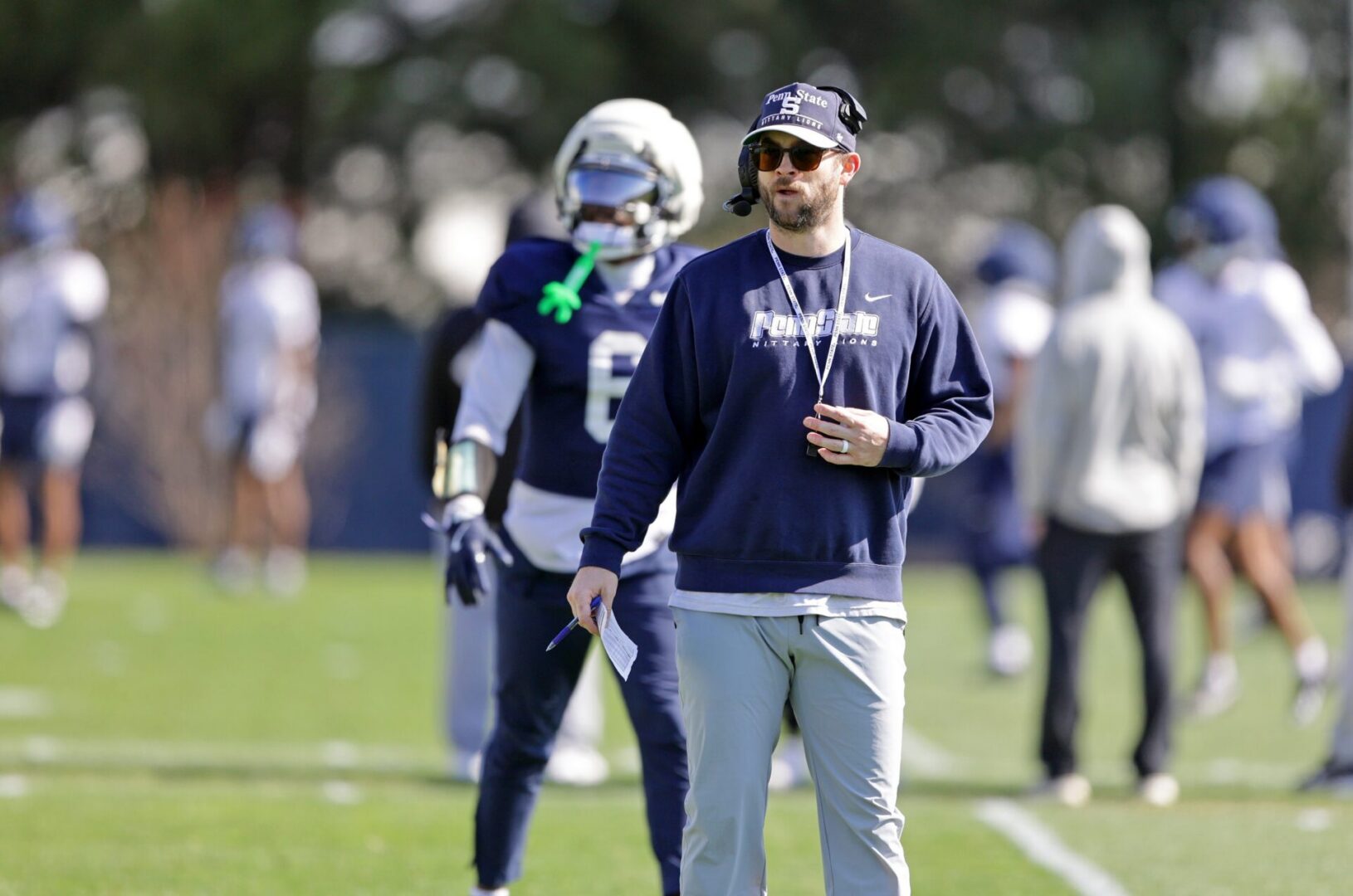
Over the course of his 2024 and ’25 seasons at Iowa State, offensive coordinator Taylor Mouser called 1,813 plays. Give or take.
The Cyclones’ offense ran that many. But head coach Matt Campbell, himself a former O-coordinator, quarterbacks coach Jake Waters and veteran quarterback Rocco Becht all had a voice — and, in Becht’s case, a hand — in determining which plays were actually called and executed.
But, of the 993 running plays and 820 passing plays that Iowa State executed from the line of scrimmage on its way to a combined 19-7 record the past two seasons, Mouser — who also doubles as the tight ends coach — was the primary offensive game-planner and play-caller.
Now, that quartet is at Penn State.
And Mouser begins Year 3 as Campbell’s OC and Becht is set to start college game No. 40 at quarterback when the Nittany Lions take the field against Marshall on Saturday in the 2026 season-opener. So, I wondered how the game plan unfolds during the week with the new crew and who calls the plays during the pressure-packed 210 minutes of a big-time college football game.
Campbell, a defensive lineman in college, was an offensive coordinator for four seasons — two at his alma mater, Mount Union, and two at Toledo, before he became head coach there. When Campbell was OC at Mt. Union, they won consecutive national titles, as his offense averaged 41.3 points per game in 2005 and 43.9 ppg in 2006. At Toledo, his offense averaged 27.9 ppg in 2010, then jumped to 42.2 ppg in 2011.
For Mouser, the 2024-25 seasons were his first years calling plays at any level. It’s a big, fast rise for the 35-year-old graduate of Adams State, where — like Campbell — he was a defensive lineman. Mouser hit the nail on the head on Tuesday, when he admitted to the local media, in an atypical showing of self-awareness in 2026 major college football:
“That’s probably been one of the bigger stories with you guys,” Mouser said. “It’s like you don’t understand how I got here. And sometimes neither do I. But it’s…it’s a dream come true to go out there on a stage like this.”
Waters, who played four seasons at quarterback in college (the last two at Kansas State after kicking the tires at Penn State when Bill O’Brien was the head coach), is in his third season as a QB coach, the previous two at Iowa State.
Then there’s Becht. He was a three-year starter at Iowa State, with a 26-13 record. If all goes well, he will have started well over 50 games as a college QB. Wow. (Bo Nix had 61.) How does that stack up against the most veteran of Penn State quarterbacks? Sean Clifford had 46 starts as a Nittany Lion QB, followed by Trace McSorley (40) and Tony Sacca (40), Drew Allar (35), Todd Blackledge (33), Chuck Fusina (31) and John Hufnagel (29).
With that in mind, let’s hear from the three principals— Campbell, Mouser and Becht — about how they go about game-planning and calling plays. All quotations are from press availabilities this past week.
GAME-PLANNING/GAME WEEK
CAMPBELL: “That has evolved over the years. My beginning of the week starts off holistically — obviously, how are we going to try to win this game, and help being involved in all three phases? Certainly involved in special teams, certainly involved defensively. But my history, my past is obviously offensively.
“If I do have an asset, I do still put a lot of time and effort into game planning in all three phases, and making sure that I can help where needed, if needed. But we have such great coaches I really feel confident that my job is more of managing the flow of the game.”
BECHT: With Mouser, “we know what each other is thinking. He’s open to all of my opinions and he’s all ears. And so to have that relationship with your OC is huge. That’s just been built over the years. I think being with those guys for three years, my head coach for five years now, I feel like you just have to build that relationship and it continues to build every single year.”
MOUSER: “In the game-plan process, Rocco is up [in the coaches’ offices in Lasch Building] with us on Monday. We’re meeting with him on Tuesday. We’re sitting down there at dinner and like, ’Would you rather do this? Do you like how we personnel this?’
“And he’s very open. He’s not like a jerk about demanding any of this. I really care about his feedback. I don’t ever want the quarterback to feel like they’re out there by himself.
“I love to get with him throughout the week and have him rank the plays. The third-down plays that we do — we game plan them. But then I have Rocco rank them and which ones does he like. I have him pick out his least favorite play on the call sheet and then we’ll probably take that one out.
“He’s the one who has to go out there and throw the passes, and I don’t have to do any of that… We put a lot on their shoulders in the game-plan process. That way, when we get to the game, we can take a lot off.”
PLAY-CALLING/DURING THE GAME
CAMPBELL: “My job as the head football coach is to manage the rhythm of the football game. We go in with a plan of how we assume the game is going to go. But as we know, that never always goes to plan.
“More tempo, more pace. How do we want to play the game? How do we want to manage situational football? Certainly, situational awareness is where I put a lot of my time and effort in-game.
“I think one of Rocco’s greatest qualities — we talk about this a lot — you don’t have to make every play on Saturday, but you got to make great decisions on Saturday. When you can go with that mindset, you got the ability, that you understand one play is one play, it’s got a life of its own — you live it, you breathe it, you understand it, you go to the next play. I think that’s one area that Rocco has excelled in. You’ve seen it even where mistakes have happened, his ability to flush it, correct it, come back and play the next play.
“Again, I think when you have confidence that the leader with the ball in his hand can live that way, I think it allows you as the coach to live that way and call the plays that way.”
BECHT: “…I can go out there and make the right decisions, get the offense rolling down the field, score as many points as we can to earn that trust – and I feel like I’ve been able to do that over the past two years with Coach Mouse.
“He kind of just reminds me to go out there and play free, have fun. You know, Coach Waters is my position coach, so he’s always telling me what to do — be smart with the ball, all that kind of stuff. Then Coach Mouser has taken a different direction of, ‘Let it rip. Go out there, don’t worry about if you throw a pick or not. Just go out there, rip the ball, trust what you see and take what the defense gives you.’
“To have that guy [Mouser] keep me level-minded and remind me to go out there and just have fun, is super-important to me because I can always get caught up in the moment and think of it as just too much pressure on my shoulders. But just to let that stress off my shoulders and go out there, just play free, it helps.”
MOUSER: “I am up in the box [calling plays during the game]. It’s a long way away from the field, which I like. It’s a great spot.
“Rocco has full control of the wheel at the line of scrimmage in the game to be able to get us in the right play, get into the play that he wants and trust what he sees because he has to be able to play fast.
“And however we can help him, we do. Obviously, we call the plays. You know, most of the time he goes out there and executes to the best of his ability. But he does have autonomy and control of the offense out there.
“Rocco demands a lot out of himself and he puts a lot of pressure on himself. I don’t want that kid to feel stressed to have to make the perfect adjustment or the perfect pass all the time. I want him to be confident to throw the ball into tight windows when he has to.
“And I’m not the quarterback coach either. So, I know Waters gets pissed at me and Campbell gets pissed at me. They say all the right things to the quarterback and I’m like, you know, ‘Go sling it man, you don’t have to be perfect.’ We can be goofy that way a little bit and have some fun.”
More Penn State Football
View all Penn State Football
Inside Alex McPherson’s ‘Night And Day’ Growth at Penn State
Penn State brought in multiple players through the portal this past offseason, including Colorado defensive end transfer transfer Alex McPherson, whose commitment didn’t garner much attention. The former three-star recruit […]
Penn State Athletics to Open Paterno Family Football Experience Room
Penn State Athletics and the Penn State All-Sports Museum announced the opening of the Paterno Family Football Experience Room on Tuesday. Located within Beaver Stadium, the permanent museum experience showcases over a […]
It’s Time to Watch Penn State Linebacker Tony Rojas… Again
Watch Tony Rojas. He’ll be back at linebacker for Penn State on Saturday against Marshall, the culmination of a journey that seemingly took him everywhere, but ultimately brought him back […]


